Sewer Line Repair & Replacement in Cypress 💧
Cypress was incorporated in 1956 and built out almost entirely in the 1960s – a compact six-square-mile city where the majority of homes are slab-on-grade construction with cast iron drain lines running beneath the concrete. Those lines are now 60 to 65 years old, dealing with decades of interior corrosion and grease accumulation from within, while in the neighborhoods along the city’s eastern edge near Coyote Creek, persistent root pressure from mature eucalyptus, willow, and ornamental trees along the creek corridor adds another layer of stress year-round.
Sewer line repair and replacement covers the main sewer line from your home to the city connection – a different scope from interior drain cleaning. Barker & Sons has been doing sewer work across Orange County since 1983, and we start every job with a camera inspection and a written report with video footage showing exactly what’s in your line before any work is quoted. With over 5,000 Google reviews at 4.9 stars and real people answering 24/7, we’re ready when Cypress needs us. For general plumbing in Cypress, our Cypress plumbers handle the full range.
Warning Signs Your Cypress Sewer Line Needs Repair or Replacement
In Cypress’s slab homes, the clearest signal that the main sewer line is involved – rather than a single interior fixture – is when multiple drains are affected simultaneously. Because the main sewer line beneath the slab is the common point of failure, problems there back up everything upstream at once. Watch for:
- Multiple drains running slow at the same time throughout the house
- Toilets that gurgle when the sink or shower drains
- Sewage odors in the yard or near exterior cleanouts
- Soft, wet, or unusually green patches of lawn with no irrigation running
- Sewage surfacing in floor drains, tubs, or low-lying fixtures
If a single slow drain is the issue, drain cleaning may be the right starting point. When the pattern affects multiple fixtures, the main sewer line is likely the cause.
What’s Under the Slab in Most Cypress Homes – and Why It Matters Now
Cypress’s 1960s building era means nearly every single-family home in the city has cast iron drain lines running directly beneath the concrete slab. There’s no crawl space, no accessible underfloor area – just concrete above and aging pipe below. At 60 to 65 years old, that cast iron is within or past its expected service life. Decades of interior corrosion have roughened pipe walls, slowing flow and creating surfaces where grease, sludge, and debris accumulate faster than they would in newer pipe. In neighborhoods near Coyote Creek, root pressure from mature trees adds another layer of stress to lines that are already working against age.
In the city’s earliest homes – those built before 1970 in the first wave of post-incorporation development – Orangeburg pipe may be present. This tar-and-fiber composite material was commonly used in post-war construction through the mid-1970s and had an expected service life of around 30 years. Any Orangeburg still in the ground has long since exceeded that. A camera inspection is the only way to know what material is actually in your line – and for Cypress slab homes, that inspection is what determines whether trenchless repair is viable or whether the pipe needs to be replaced entirely.
How We Repair Sewer Lines in Cypress: Camera First, Then the Right Method
Our four-step process for every Cypress sewer job:
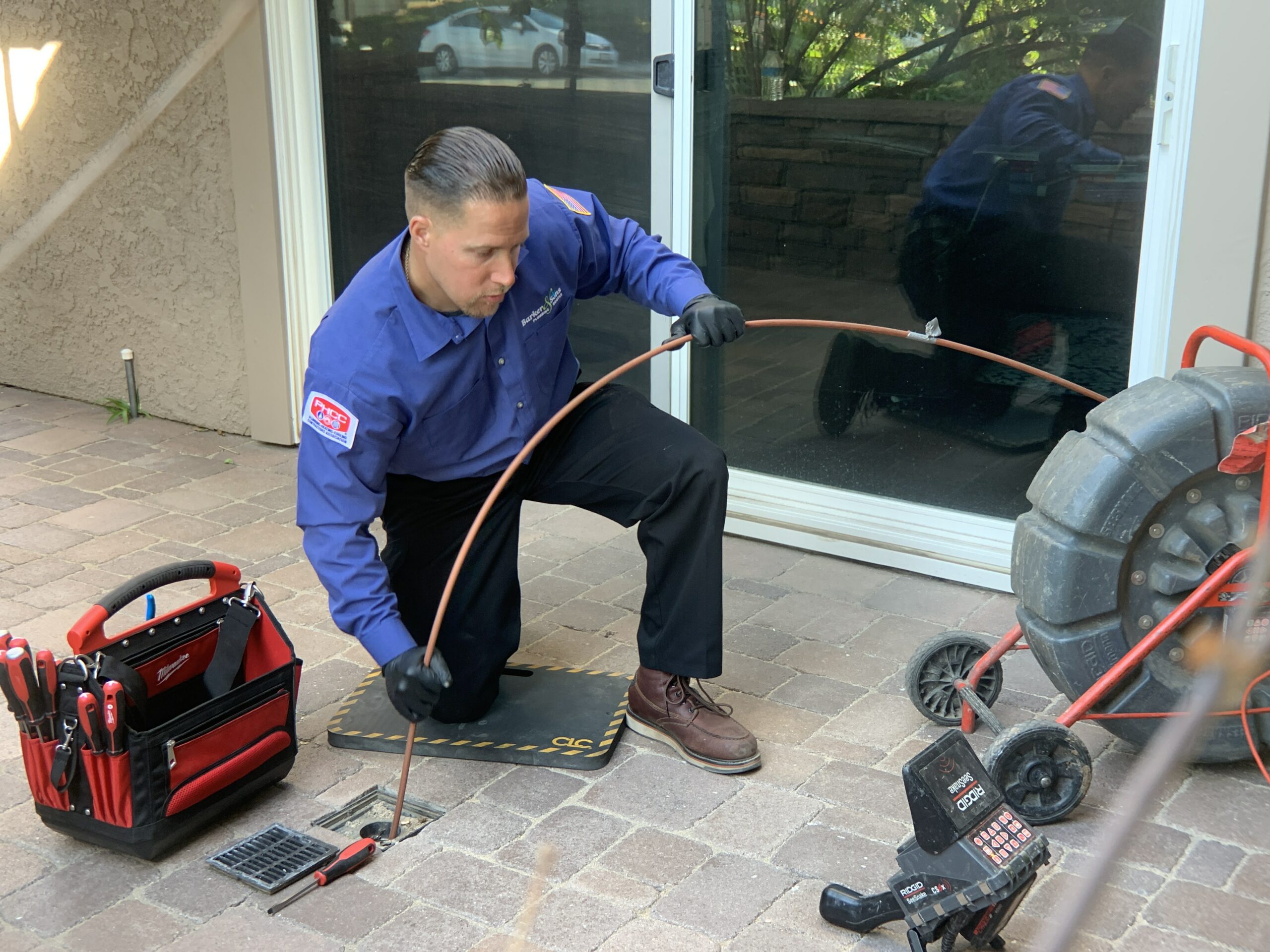
Step 1 – Camera inspection: A camera goes in the line before any recommendation is made. We map root intrusion locations, scale buildup, cracks, displacement, and material condition.
Step 2 – Written report with video footage: You receive a written diagnosis with the actual camera footage. No guesswork, no verbal descriptions – you see exactly what’s in the pipe.
Step 3 – Repair or replacement: Based on what the camera shows, we recommend and perform the right method. For slab homes, camera footage is especially critical because it determines whether trenchless lining avoids cutting through the foundation – or whether the pipe’s condition makes that impossible.
Step 4 – Final camera inspection: Once the repair is complete, the camera goes back in to confirm the work was done correctly. You see the before and after.
When repair is the right call: Damage is isolated, the pipe wall has enough structural integrity to hold a liner, and a targeted fix restores full function without touching the rest of the sewer line.
When replacement is the right call: Camera shows widespread deterioration, Orangeburg has collapsed or is delaminating, or cast iron has corroded through the point where lining won’t hold.
Trenchless Sewer Repair in Cypress: Pipe Lining and Pipe Bursting
Trenchless sewer repair is the preferred method for most Cypress residential jobs – and in slab homes specifically, it’s the difference between a repair that leaves your foundation intact and one that requires cutting through concrete to access the pipe.
We use two trenchless methods:
- Pipe lining (CIPP): An epoxy-coated liner is inserted into the existing pipe and cured in place, creating a new pipe within the old one. Effective for cast iron with isolated cracks, scale buildup, or root intrusion where the pipe wall still has structural integrity.
- Pipe bursting: The deteriorated pipe is fractured outward while a new pipe is simultaneously pulled through. Used when the existing pipe is too far gone for lining, including Orangeburg that has collapsed or delaminated, but trenchless access at both ends is still available.
Trenchless is also the most practical approach for the east Cypress neighborhoods near Coyote Creek, where higher soil moisture from the creek corridor creates elevated root pressure and where open excavation near established tree root systems is more disruptive than elsewhere in the city.
Traditional Sewer Line Replacement in Cypress
When the camera confirms that trenchless methods aren’t viable, full pipe collapse, severe displacement, or material too deteriorated for lining to hold, open-cut excavation is the right path. Barker & Sons performs complete sewer line replacement in Cypress when that’s what the footage warrants.
Any sewer work within the City of Cypress public right-of-way requires permits through the City of Cypress. We handle that coordination from start to finish by pulling permits, managing inspections, and ensuring compliance with city requirements. The excavation area is properly restored before we leave.
Why Cypress Homeowners Choose Barker & Sons
Other companies claim local expertise in Cypress without being able to name a neighborhood, a pipe material, or a local condition. We can.
- Over 5,000 Google reviews at 4.9 stars – OC-concentrated, not aggregated across Southern California
- In business since 1983 – 43+ years of sewer experience in Orange County, including Cypress’s 1960s slab neighborhoods
- Camera inspection and written report on every job – you see the footage before any work begins
- Trenchless specialists – pipe lining and pipe bursting that protect Cypress slab foundations and avoid slab cutting in most situations
- Coyote Creek corridor experience – we know what persistent creek-corridor soil moisture does to root pressure near east Cypress sewer lines
- City of Cypress permit coordination – all permits and inspections handled on your behalf
- No overtime charges – same rate nights, weekends, and emergency calls
- Real people answering 24/7 – not a voicemail when something fails at midnight
Ready to Find Out What’s in Your Cypress Sewer Line?
Barker & Sons has been serving Cypress and Orange County since 1983. Over 5,000 Google reviews at 4.9 stars. Real people answering 24/7. Call us or schedule online, we start with a camera inspection and a written report so every recommendation is based on what’s actually in the ground.
Cypress Sewer Line Repair & Replacement FAQs
Yes, the creek corridor maintains persistently moist soil year-round, drawing mature eucalyptus, willow, and ornamental tree roots toward buried sewer line connections more aggressively than in drier parts of the city.
Most 1960s Cypress homes have original cast iron drain lines beneath the slab foundation – now 60 to 65 years old and dealing with decades of interior corrosion, grease accumulation, and soil movement. A camera inspection is the only way to see their actual condition without cutting through the concrete.
Orangeburg is a tar-and-fiber composite pipe used in post-war construction through the mid-1970s with an expected service life of around 30 years. It typically deteriorates by delaminating and collapsing inward. If your Cypress home was built before 1970, a camera inspection will confirm whether it’s present.
Cast iron lines in slab homes run beneath the concrete foundation, so traditional excavation requires cutting through the slab to access the pipe. Trenchless pipe lining and pipe bursting work from access points at either end of the damaged section and leave the slab completely intact.
Pipe lining installs an epoxy-coated liner inside the existing pipe without removing it, while pipe bursting fractures the old pipe outward and pulls a new one through. Both are trenchless and the right method depends on the pipe wall’s condition as shown on camera.
Yes, we coordinate the entire permit process with the City of Cypress on your behalf, including all required inspections for any work involving the public right-of-way.
The inspection maps root intrusion locations, scale buildup, cracks, pipe displacement, and material condition and we provide a written report with actual video footage so you see exactly what’s in the line before any recommendation is made.
Trenchless repairs typically wrap up in one to two days; traditional excavation generally takes two to three days depending on line length and permit timing, but we’ll give you a clear schedule before any work begins.