Sewer Line Repair & Replacement in Brea, CA
Brea was incorporated in 1917, and its sewer infrastructure spans more than a century of development – from the clay tile sewer lines beneath the historic downtown blocks built in the 1920s and 1930s, through the cast iron drain lines of the mid-century slab-on-grade tracts, to the hillside developments in Eagle Hills and along the Carbon Canyon corridor. What’s in the ground under a Brea home depends almost entirely on when and where it was built. Getting that answer right before any repair is quoted is why every job we take starts with a camera inspection.
Barker & Sons has been repairing and replacing sewer lines across Orange County since 1983. We answer calls 24 hours a day, seven days a week – including Sundays. With over 5,000 Google reviews at 4.9 stars, we’re ready when Brea needs us.
What’s Actually in Brea’s Sewer Lines Depends on When Your Home Was Built
The pipe material, service life, and most common failure modes in Brea vary significantly by neighborhood era – and that context changes everything about what a repair should look like.
Downtown Brea and the historic neighborhoods (1920s–1950s): The residential blocks surrounding the Brea Boulevard arts district and downtown area have original clay tile sewer lines and cast iron drain lines that are now 70 to 100 years old. Clay tile at this age is highly susceptible to root intrusion through deteriorating joints, and the mature liquidambar, sycamore, and jacaranda trees that line Brea’s downtown streets have had decades to grow root systems toward those connections. These are some of the oldest active sewer lines in north Orange County, and by the time a backup surfaces, the root mass inside the pipe is usually well-established.
Mid-century slab tracts (1950s–1970s): The post-war residential development that filled in much of flat and gently sloped Brea brought cast iron drain lines on slab-on-grade foundations. Those lines are now 55 to 70 years old – and at that age, cast iron corrodes from the inside out, with roughening interior walls that collect grease, sludge, and debris faster than newer pipe. In slab homes, the pipe sits directly beneath the concrete foundation, completely invisible without a camera and inaccessible without one too.
Hillside developments (1970s–1990s) – Eagle Hills, North Brea, Carbon Canyon corridor: Newer pipe here, but different challenges. Hillside sewer lines develop grade-related problems over time: bellying in low spots where solids collect, and joint stress from slope movement that flat-lot properties don’t face. Large lots in these areas have mature native oaks and hillside vegetation with root systems that reach buried sewer lines during dry seasons.
How to Know When Your Brea Sewer Line Needs Attention
In Brea’s older downtown neighborhoods, warning signs often develop slowly because clay tile fails progressively. The pattern to watch for: a backup that clears temporarily but returns within days. That cycle usually points to the main sewer line, not an interior fixture drain. Watch for:
- Multiple drains running slow throughout the house at the same time
- Toilets or sinks that gurgle when other fixtures drain
- Sewage odors in the yard or near exterior cleanouts
- Soft, wet, or unusually green patches of lawn without irrigation running
- Sewage surfacing in tubs, floor drains, or low-lying fixtures
If slow drains are the issue rather than the main sewer line, drain cleaning in Brea is the right starting point.
Sewer Line Repair or Replacement – How the Camera Makes the Call
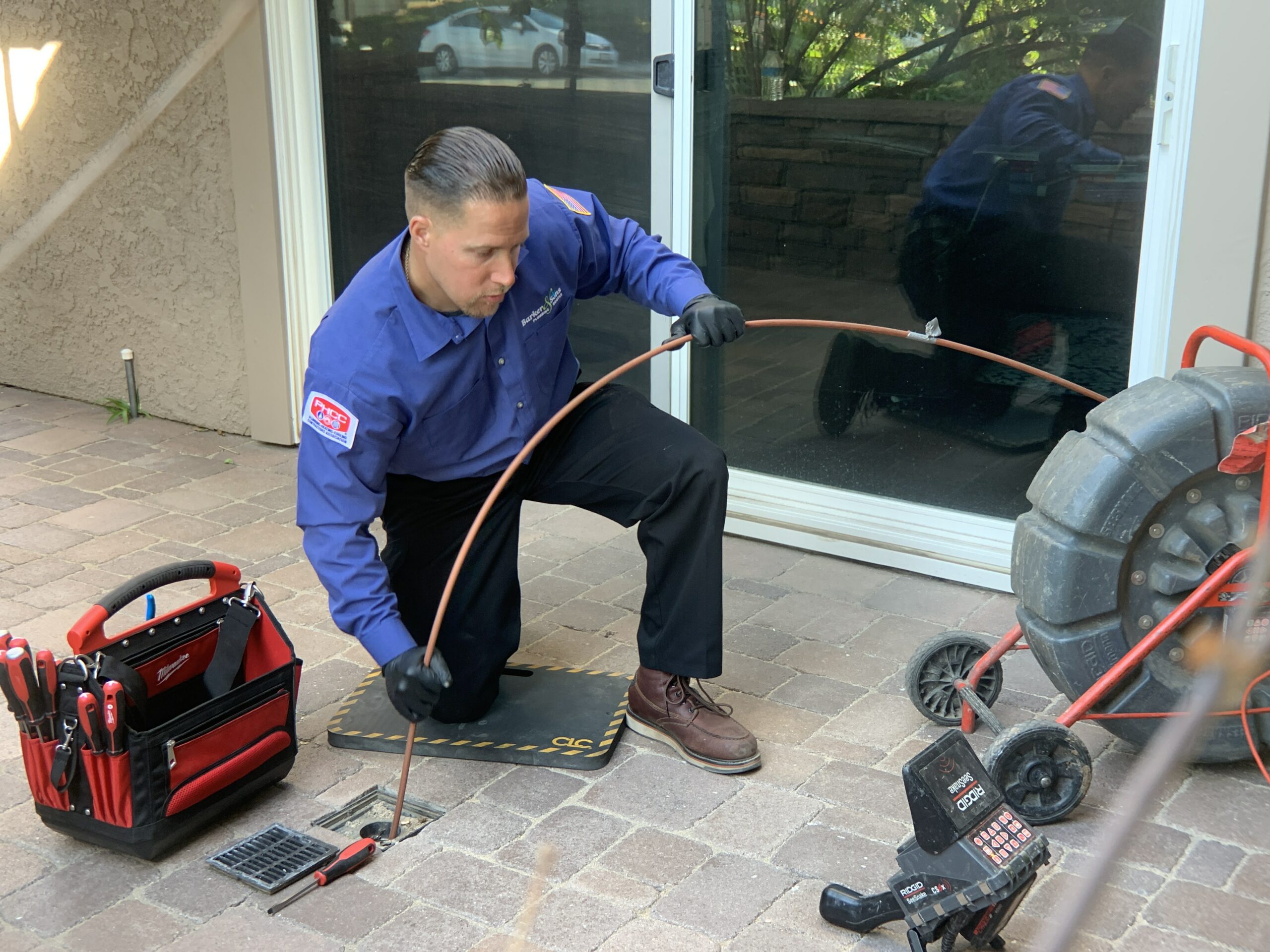
Before any recommendation is made, a camera goes in the line. The footage tells us the pipe material, where damage is located, how extensive it is, and whether lining is structurally viable. In Brea, where pipe age varies significantly by neighborhood, that distinction matters.
Repair is typically the right call when:
- Damage is isolated to one section with sound pipe on either side
- Root intrusion is at a single joint that can be cleared and lined
- The pipe wall has enough structural integrity to hold a CIPP liner
- A targeted fix restores function without touching the rest of the sewer line
Replacement is typically the right call when:
- Camera reveals deterioration or joint failure across multiple sections
- Clay tile has fractured or collapsed through a significant portion of the line
- Cast iron has corroded to where lining is no longer structurally viable
- The same line has been repeatedly cleared without lasting results
Downtown Brea homes from the 1920s–1940s frequently tip toward replacement because clay tile joint failure rarely stays isolated at this age. Mid-century cast iron from the 1960s is often still in repair territory with camera confirmation.
Trenchless Sewer Repair in Brea: Pipe Lining and Pipe Bursting
Trenchless sewer repair is especially practical in downtown Brea, where mature street trees mean open excavation involves clearing root systems before a trench can even be dug – pipe lining avoids that entirely. It’s also the preferred method in Brea’s slab-on-grade mid-century homes, where traditional excavation requires cutting through the concrete foundation to reach the pipe.
We use two trenchless methods:
- Pipe lining (CIPP): An epoxy-coated liner is inserted and cured in place inside the existing pipe, forming a new pipe within the old one – no excavation required.
- Pipe bursting: The deteriorated pipe is fractured outward while a new pipe is simultaneously pulled through – a full replacement with minimal surface disruption.
The camera footage determines which method is appropriate for your specific situation.
Traditional Sewer Line Replacement in Brea
When trenchless methods aren’t viable, collapsed pipe, severe misalignment from hillside movement, or material too deteriorated for lining to hold, open-cut excavation is the right call. Barker & Sons performs complete sewer line replacement in Brea when the camera warrants it.
Sewer line work within the City of Brea’s public right-of-way requires permits through the City of Brea Street/Sewer/Storm Drain/Sanitation Division. We coordinate that process on your behalf from start to finish – you won’t be managing city paperwork while your sewer system is down. The excavation area is properly restored before we leave.
Why Brea Homeowners Choose Barker & Sons
- Over 5,000 Google reviews at 4.9 stars – consistent trust across Orange County
- Real people answering 24/7, including Sundays – when a sewer backup happens on a weekend, you reach a person immediately
- Camera inspection before every recommendation – you see the footage before any work is quoted
- Full repair and replacement coverage – trenchless and traditional, matched to what the camera shows
- Free estimates, no overtime charges – the same rate nights, weekends, and Sundays
- City of Brea permit coordination – we handle the Street/Sewer/Sanitation paperwork on your behalf
- In business since 1983 – 43+ years working in Brea’s downtown neighborhoods, hillside properties, and everything in between
Brea plumbers from Barker & Sons handle the full range of plumbing needs across the city. When the sewer line is the issue, this is where to start.
Ready to Find Out What’s in Your Brea Sewer Line?
Barker & Sons has been serving Brea and Orange County since 1983. Over 5,000 Google reviews at 4.9 stars. Real people answering 24/7, including Sundays. Call us or schedule online. We always start with a camera inspection so every recommendation is based on what’s actually in the ground.
Brea Sewer Line Repair & Replacement FAQs
Almost certainly original clay tile for the sewer line and cast iron for the drain lines, both are now 80 to 100 years old, well past reliable service life, and the downtown tree canopy has had decades to grow root masses into pipe joints. A camera inspection shows exactly what’s in the line and whether repair or replacement makes more sense.
Drain cleaning clears blockages in interior fixture lines; sewer line repair addresses the main sewer line from your home to the city connection. However, if backups keep returning after clearing, or multiple fixtures are affected at once, the main sewer line is likely the issue.
Mature street trees throughout the historic neighborhoods mean open excavation requires clearing root systems before a trench can be dug. Pipe lining works from access points at either end of the damaged section with no surface disruption, avoiding that entirely.
Yes, hillside sewer lines develop grade-related bellying and joint stress from slope movement that flat-lot properties don’t experience, and large lots with mature native oaks generate significant root pressure. Camera inspection is especially important for hillside homes because these problems don’t show up on the surface.
Pipe lining installs an epoxy-coated liner inside the existing pipe without removing it, while pipe bursting fractures the old pipe outward and pulls a new one through. Both are trenchless and the right method depends on the pipe’s wall condition as shown on camera.
Yes, we coordinate the entire permit process with the City of Brea Street/Sewer/Storm Drain/Sanitation Division on your behalf.
Trenchless repairs typically wrap up in one to two days; traditional excavation generally takes two to three days depending on line length and permit timing.
If intrusion is caught early and the pipe wall is sound clearing and lining can resolve it. If roots have been growing inside the line for years and the clay tile is compromised, replacement is usually the more durable answer.